DOTF at VidCon Australia present ‘Don’t F*** Up Your Video Strategy’

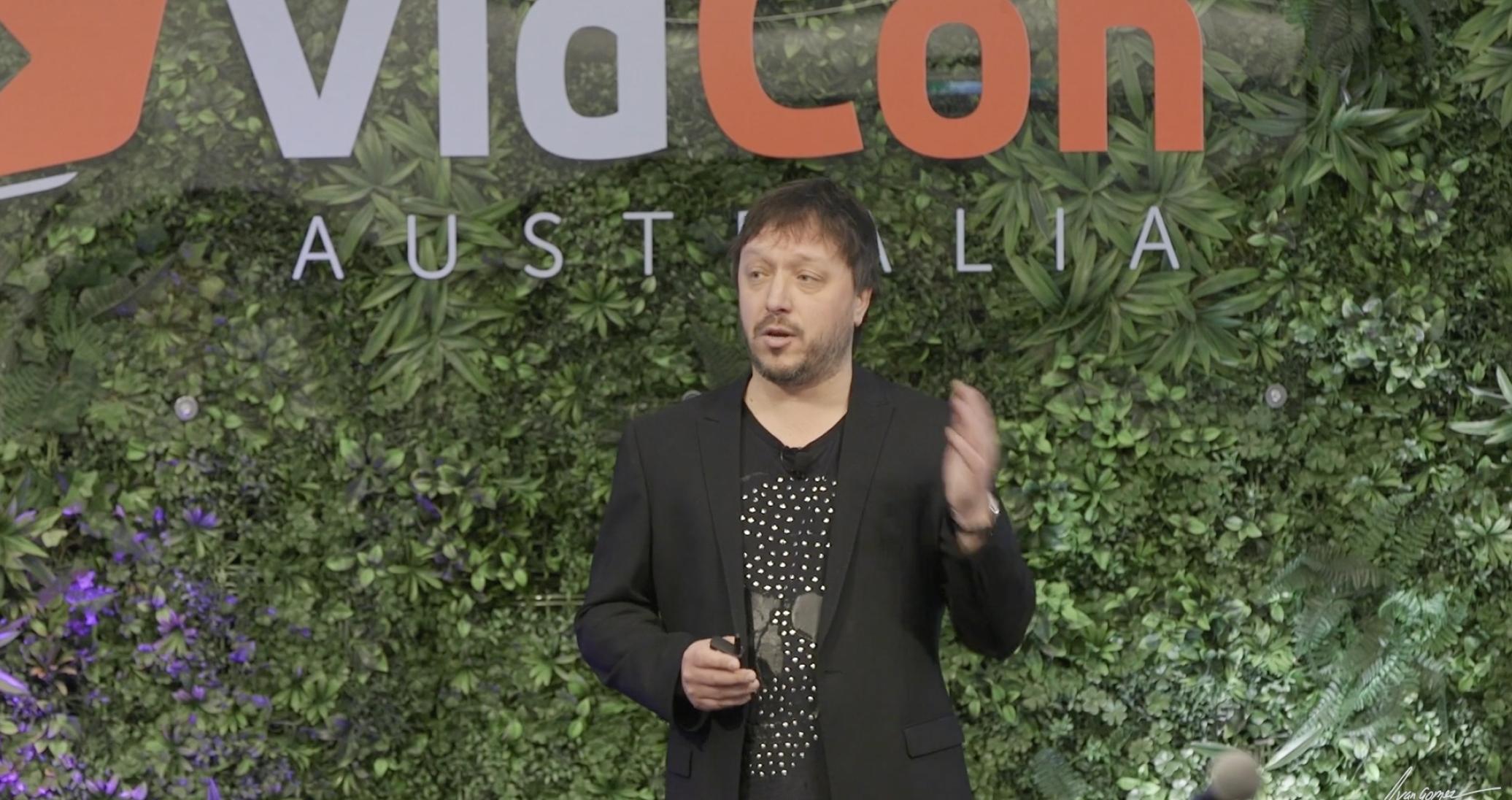
If you want powerful insights into strategy, video content, marketing, and creative, then we have the perfect event for you. Our Managing Director Ivan Gomez has over 25 years experience in fashion, branding, marketing, content creation, video production, design and events management. He’s been our fearless leader here at Department of the Future since he began the company 10 years ago, and he’ll be delivering a presentation at VidCon Australia 2019 – “Don’t F*** Up Your Video Strategy: How to Create Content That Delivers ROI and Community Growth.”

In his time, Ivan has picked up a valuable trick or two. He’s learned how to speak to different audiences with authentic storytelling, and emotive content. He’s learned how to get the best out of real people to create blockbuster campaigns incorporating user generated content for massive organisations like Cricket Australia. He’s worked with brands like Telstra, HTC, Sensis and more, while also working with charities like NAIDOC and the Brotherhood of St Lawrence, helping organisations with causes close to his heart. Whether the client is big or small, Ivan and the DOTF team have always strived to create authentic, relevant content – because this is the most powerful asset for any brand.

If there’s one thing Ivan has taken away from his career in video so far, it’s that too many brands and organisations f*** up their video strategy, or create content that isn’t relevant to their audience. “Nothing drives me crazy more than brands not understanding the importance of video.” Ivan explains. “It literally accounts for 80% of ALL online traffic – audiences crave it. So, brands have to start getting it right, or risk being left behind.”

Ivan will offer valuable insights about how to make your content relevant to your audience, and how to blow up its reach, so you can scale and grow your business. Whether it’s internally created, user-generated, or made by an external company, your content has to be genuine and mean something to your audience – otherwise, why the f*** are you making it?
VidCon Australia 2019 will be held at the Melbourne Convention Centre in South Wharf, from 18/09 to 22/09. Check out the full agenda here and catch Ivan at 9:00AM on 20/09 in Eureka 2-3.

Top Video Marketing Trends for 2019

For over a decade, DOTF has been saying that video content is king – and the statistics don’t lie, with over 81% of individuals purchasing a product after viewing video content, and 76% of marketers agreeing that using video has increased their sales.

Google also recently announced that auto-playing video previews will be a significant part of mobile searching – and that they’ve been using clever AI to read captions and transcribe audio tracks to make video searchable beyond clever captioning and tagging – making 2019 undoubtedly the year of video. Whilst our favourite trends from 2018 are still going strong and are definitely informing our picks, here is our outlook for 2019.

Vertical Video

Whilst 2018 was the year of diverse aspect ratio, 2019 bows to vertical.

Sure, widescreen still offers cinematic gloss for that YouTube presence (which absolutely should not be underestimated) and 1:1 looks great on the Insta feed. However, as IGTV, Stories and Snapchat continue to rise (and Facebook and Instagram post are lost to the incomprehensible world of the algorithm) that lanky 9:16 ratio is where you’ll want your video to go. We’ve been creating and recommending a vertical video for the past couple of years – but in 2019 it’s essential if you want to make sure that your content is seen.

Adidas Originals Superpower Vertical Mobile Ad 2016, directed by Jan Foryś and found on YouTube

E-Learning

Selling isn’t the only path to monetary rewards with video.

Branded video content is obviously the most effective way to engage an audience, leading to increased sales and better brand awareness – however, e-learning content can save employers significant amounts of time and money.

Employees have to be trained – and this is often a time-consuming and expensive process. Training video modules that can be done by the individual at home, or in less time and cost than required to take a day out of your employee’s schedule, book a trainer, put on refreshments and all of the other costs and time-wastage that is associated with upskilling. E-learning can teach more with less and offers flexible engagement in previously unseen ways.

Additionally, e-learning content can be combined with promotion in order to engage your audience, and associate the brands with newly acquired knowledge or skills. This has been done with best success by food brands, moving their serving suggestion recipes into the video realm – and cosmetic brands, engaging to create tutorials of looks featuring their products – but can be applied to a broad range of brands with some creative thinking.

Live Video

Video In The Moment

DOTF prioritises authenticity when it comes to connecting brands with audiences, and the use of the live video function across Facebook, Instagram, Snapchat, YouTube and Twitch provide a great opportunity for a real connection with your demographicm with viewers spending more than three times the amount of time on a live video compared to a pre recorded video.

Why go live? The main benefits are real-time connection, humanising your brand (which is of ever-increasing importance in 2019, as consumers bring their ethics with their purchasing power), setting customer expectations and the ability for immediate insights into how your audience views your brand. Also, it can be incredibly cost effective.

You could do a Q&A, like Sephora, take Apple’s lead and bring your global audience to you as you launch a new product, or combine live video with the e-learning trend to broadcast live classes and tutorials – a format particularly popular in the fitness and hospitality sectors.

Our top tip for going live is to work with a content agency who can help to plan your broadcast and offer contingencies and suggestions for live engagements that will bolster your brand and capture your audience. Whilst the brilliance of live
video is that your brand and your audience experience simultaneity, sometimes this can go horribly wrong – just ask Lindsay Lohan.

Shoppable Content

Watch, Want, Buy.

Whist shoppable content has been around for a while, we imagine that 2019 is the year that it goes mainstream. Shoppable content involves stickers, notes or additional on-content features (such as YouTube has been doing for a few years now) that allows the content viewer to purchase a product featured in the content directly from the content – no additional website trawling. Watch, want, buy.

Instagram has joined the game, and whilst they’ve had shoppable posts for a while now, they’ve recently recently introducing product “stickers” (featuring product name, price, description and link to online commerce locations) can be included in Instagram Stories, making it easier to own the product that’s caught your eye.

The benefit of shoppable content is that it allows brands to move further away from traditional advertising, and concentrate on authentic engagmenet and building a relationship with their audience – attracting loyal customers and improved sales.

Content Length

The Long and the Short of It

Content length is definitely up for a shake-up in 2019, and whilst the 15-120 second videos will still reign supreme, it’s worth considering looking at significantly shorter videos – and significantly longer.

Whilst Vine may have died, its six-second format left an indelible mark on the video content world. However, that’s not a lot of time to work with. The best way to use that six seconds? Make the content support additional content, working as an element of a larger suite of content, or bigger holistic campaign. You can keep it simple, by ensuring that images, text and colours immediate evoke your brand – or you could go for something quick, cheeky, shocking and fun (following the Vine tradition). In fact, some of the world’s top advertising creative suggest treating the six-second video like a joke. Short. Sharp. Punchline.

OW001B – Video 2a – Marcus – Buzzfeed Answers – if you were a girl vignette from Department of the Future on Vimeo.

Laminex – Anna – Stop Motion from Department of the Future on Vimeo.

MasterCard 6 Seconds from Department of the Future on Vimeo.

On the other end of the spectrum, brands are investing in longer form content, using storytelling to support their brand’s ethos and perception rather than necessarily sell specific products or services. Chevrolet teamed with acclaimed filmmaker Spike Lee to create a 17-minute documentary about a young female baseballer. The only overt brand presence are the cars used a mode of transport in the final scene, and rather than closing credits, the film ends on the Chevrolet logo. It’s a lovely, moving film and a big name director gives it legitimacy, and gives the audience a warm feeling about Chevrolet as a brand. Tech and telelcommunications brand took it even further, creating a 30 minute short drama, starring Olivia Munn and Joan Chen, showing technology in (admittedly, dramatized) context.

Here at DOTF, we’ve championed long-form branded content, creating half-hour and broadcast hour documentaries for HTC and Deakin University.

Deakin University – Business – TVC from Department of the Future on Vimeo.

Authenticity

The power of real people.

Influencers and brand ambassadors can be great ways to draw attention to your brand, but at DOTF we’ve always championed authenticity – using real people involved with a brand to represent that brand – and we’re pleased to see this trend emerging for 2019.

Whether it’s the behind-the-scenes crew for Bon Appetit’s test kitchen becoming influencer purely through being real people, doing their jobs, or showing an authentic experience of a student study trip through video diaries and fly-on-the wall documentaries, as we did for Deakin University, the appeal of the real is on the rise.

Audiences from the Millennial generation and younger are notoriously brutal with brands they see as disingenuous – and this includes the involvement of celebrities and influencers with brands that don’t seem authentic. Even celebrities are happy to call out the hypocrisy, with The Good Place star Jameela Jamil’s calling out Kardashians, Cardi B and the “fit tea” trend for inauthentic representation.

Content Partners

Following on from the authenticity discussion, we foresee that brand collabs – already a significant presence across social media with influencers and personalities – will evolve into content partnerships – brands accessing authenticity and existing audiences through video content creators – with high-quality content with authentic reach as the result.

This is another trends we’re excited about at DOTF, as this is the exact format we’ve used for content creation for over a decade, starting with our youth culture platform, Speaker TV. Whilst content partners could simply mean creating the content for a brand, or incorporating that brand directly into your existing content format, the content becomes more powerful whether both names are brought to the table equally, resulting in new, collaborative content.

Our national campaign for the HTC One was created this way, mixing HTC’s brand strategy with our brand at Speaker TV, resulting in a series of events all along the East Coast, and online content featuring the HTC brand interacting with the Speaker TV demographic in an authentic way.

DOTF 10th – Vignette – 2013 – HTC from Department of the Future on Vimeo.

What other trends do you see on the horizon? Leave us a comment below!

What We Talk About When We Talk About Graphics

What we now classify as a “video” is made up of a multitude of elements – and graphics have fast become some of the most significant elements. But what do we mean by “graphics”? When you’re reading a treatment or quote, what does “graphics” cover?

At DOTF, we use the term “graphics” to refer to any imagery created in a video that has not been created through a camera. This includes motion graphics, animation, 3D rendering, lower thirds, endframes, keying, special effects and more. Confused? Have a read through our quick glossary below.

Motion Graphics

Is it a graphic that moves? It’s a motion graphic. It’s not necessarily a full animation, but it is animated – in the sense that it is moving, not still. Mostly used to refer to logo and text elements, such as lower thirds, titles and endframes.

Animation

Whilst the difference between animation and motion graphics is widely discussed, argued and varies from place to place, here at DOTF we like to define animation specifically as a motion graphic that has been created specifically for the video. An animation doesn’t involve making existing still assets move – that’s motion graphic – but drawing, designing and creating something entirely new for the video.

Play Video

We offer a wide range of animation services – keep your eyes peeled for a blog about them!

3D Rendering

A 3D rendering is a sub-group of animation. Working in 3D is more intensive than standard animation, but can be particularly effective, depending on your goals, style and audience.

Play Video

Lower Thirds

Present in most documentary or ‘real life’ content (see: the news) a lower third is onscreen text, usually positioned in the lower third of the screen, that gives names and other appropriate information about what’s happening on screen. They’re also known as straps, chyrons, and supers.

Information displayed is not limited to names – they may be calls-to-action, URLs, location information, anything appropriate for the content being created. They may be static or animated, depending on the style of the content. Fonts and additional assets will usually be drawn from a brand’s existing style guide for cohesion, unless requested otherwise.

Play Video

Dynamic text

Also known as dynamic typography or titles, ‘dynamic text’ differs from lower thirds, in that it moves off and onscreen positioned wherever necessary through-out the content. Dynamic text is frequently used to emphasise key messaging and calls to action, and may consist of key words, short sentences or even directly quote what is being said onscreen.

Play Video

Endframes

A fairly self-explanatory entry, endframes are generally the last visuals of the video. They frequently have a logo, a call-to-action or tagline and contact details for the brand. This almost always involves motion, either of the logo, the text or any other details. It’s like the credits of the video – only instead of listing cast and crew, it’s telling your audience how to find your brand.

Play Video

Keying (also known as Chromakeying)

Keying is when we get the old greenscreen out – although as our post-production and graphics programs become more sophisticated, that’s not always necessary. Keying is used to replace one part of an image with another – for an effect that is smoother, cleaner and more natural than just layering the other image over the top.

Personally, we prefer the authenticity of shooting on location or in our inhouse studio, but keying can really help to clean up a background of an interview to avoid distractions.

Play Video

Special Effects (SFX)

Anything you can imagine, you can create via SFX. It involves a broad range of motion graphics skills and depending on the level of effects, might need some serious computing power. Set things on “fire”, remove numberplates from cars in the background, blur faces, change streetsigns – these are just a handful of things we’ve done for our clients. Whilst some SFX are used to clean up videos (for example, numberplate removal), most should be planned in the pre-production phase – and a good content agency will be able to advise if any are necessary for your content in the early stages of planning.

Play Video

Facebook’s New Augmented Reality Advertising Feature

The key to making powerful advertising content is to allow your audience to see themselves in that content. To create a meaningful connection between brand and audience, it is of paramount importance that the person being targeted relates to the content and feels as though it speaks to their world.

Perhaps there is no better way to do this than through augmented reality. A great example of augmented reality working to a brand’s benefit is Dulux’s ‘Paint Colour Visualizer’. With this online application, users can upload photos of their house, and test out different paints from the Dulux catalogue, seeing what rooms in their house would look like with different colours. This allows people to experience a product before actually purchasing it, and it’s a powerful tool. If a colour scheme they try looks perfect in the photos, chances are they will purchase those colours from Dulux.

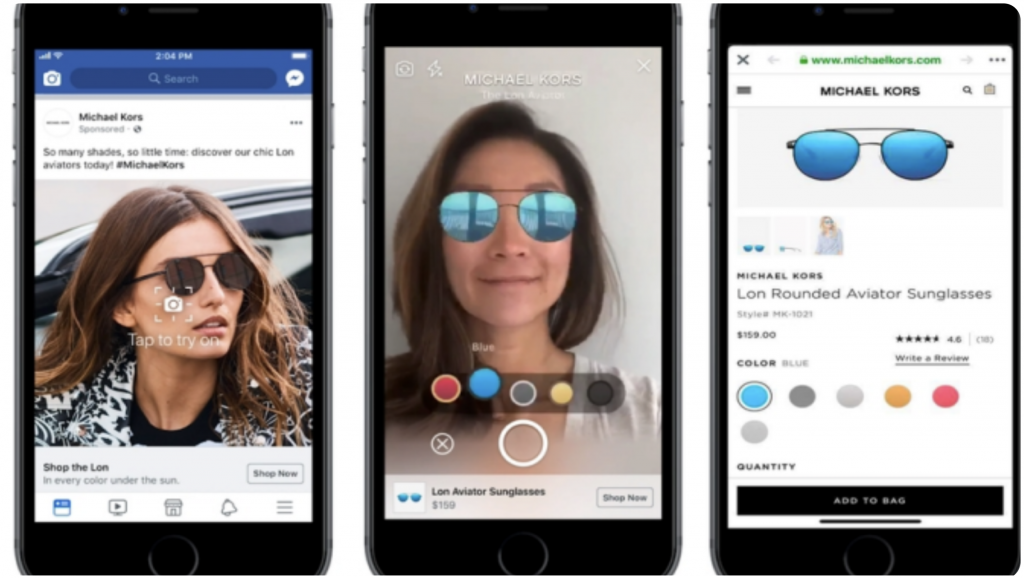
Facebook is taking this line of thinking one step further. Although using AR to allow customers to see how a product will look on them is not a new concept, this is the first time that a major social media network has brought this technology to their audience. At its F8 developer conference in 2018, Facebook announced that it was working with businesses to use AR as a way of showing off products in Facebook messenger. Now, this experience will be integrated into the Facebook News Feed, with select advertisers trialing AR ads.

Facebook’s Vice President of product marketing Ty Ahmad-Taylor demonstrated ads which allowed shoppers to see how things like sunglasses and makeup would look other own faces, through AR. “People traditionally have to go into stores to do this,” he explains. He notes that people “really love” the notion of testing a product with AR, but that they would “like to try it at home.” Thanks to this development, now they can. Brands such as Sephora, NYX Professional Makeup, Bobbi Brown, Pottery Barn, and Wayfair will be some of the first to test the waters of this new online marketing frontier. The content will appear as normal News Feed ads, however, they will have a ‘tap to try it on’ option, allowing users to access the AR functionality of the ad.

One of the hardest things about the advent of online shopping is that people can’t be certain how a product will look on them. At times, something may look great in an image, but once a consumer receives the product, they could be disappointed by how it looks on them. This new technology could make that problem a thing of the past, allowing users to digitally experience a product before they purchase it, creating greater consumer confidence. In order for content and advertising to grow, it needs to be personalised for an audience, and be experiential – Facebook’s AR advertising initiative is an excellent example of a practical implication of this philosophy. Time will tell if the endeavour will be a success for the social media giant, but this technological development could change the way that consumers purchase products forever.

How to Make Content Work For You

Social media has become the most common Internet-based activity, created a new form of social engagement and is absolutely a legitimate form of communication and connection, not only person-to-person, but brand-to-audience. The core of this connection is sharing by personal referral, with content – and in particular video content – being the key medium to facilitate this connection. This sharing provides the opportunity for brands to circulate information to wide demographics of potential customers without traditional mass media process or expense.

But how can you create the content that your audience will share, to gain new customers and continue to establish your brand DNA?

Keep Up To Date

Know what’s going on with your target demographic. All content should be interesting, and most importantly, relevant to your audience. This applies not only to the messaging of your content, but to the style and the medium. As video is the most popular form of online content, you should always be aware of new platforms and formats for the best engagement. For example, if you’re not making vertical video content, microcontent and taking advantage of Snap Ads, IGTV and Facebook Canvas, it’s time to do some research.

Get in the habit of staying up to date with trends and news in content creation by following blogs, like this one, and industry news aggregators, like Mumbrella, to ensure your content and strategy stays relevant.

Schedule

Content creation and distribution is not a set-and-forget game anymore. Where once a quarterly campaign with a print, broadcast and outdoor spend might have been sufficient, online content moves as quickly as the Internet does, and that breakneck speed also applies to brand relevance. A steady schedule of content for online and particularly socials, is an absolute necessity for solid brand DNA.

This doesn’t necessarily mean you need a new campaign each month, or a 1,500 word blog every weekday, but an agile schedule of content split between video, copy, images, audience engagement, themes and news should be the very first step in making content work for your brand.

Going back to the breakneck speed of the internet, if you’ve scheduled a post a fortnight ago, and it’s no longer relevant or the joke has passed, don’t feel obliged to post it. There’s nothing worse than a brand late to the party, awkwardly brandishing a meme. On the contrary, if there’s breaking relevant news, or a particularly applicable meme of the week, don’t be afraid to spontaneously engage your audience with relevant content.

Curate Content

Content curation is one of social media’s primary functions – sharing a video on Facebook, retweeting, pinning an image, but as I alluded to above, your content messaging must be relevant.

Marketing expert Guy Kawasaki suggests that you must “You must position yourself as an expert and genuinely interact with your communities.” That means reflecting on what works with your audience and what doesn’t, what will add value and what won’t. A well-curated Instagram account that posts three times a week would support your brand messaging and gain a more loyal audience than an Instagram posting any information multiple times a day.

Again, this doesn’t apply just to messaging, but to aesthetic. Your demographic wants to trust your brand, and maintaining an aesthetic through the content you create and curate is reassuring and will keep your audience returning.

A Content Agency

Whilst content marketing can be done inhouse, heading to a content agency is an increasingly popular option. Here at DOTF, we offer a combination of strategy, creative and content creation following a non-traditional marketing process which allows for a greater efficiency of content through collaboration with our clients. What does ‘greater efficiency’ mean to us? It means campaigns that are delivered quickly to stay relevant, nimble enough to span multiple demographics and platforms and of course, a maximised ROI for our clients. Approaching campaigns with a foresight mindset to challenge the norm, disrupt and innovate, we create powerful content with a focus on authentic storytelling. Plus, working with our strategic and creative team will leave you more informed about your brand and your audience, and armed to create content and solid strategy independently of a traditional marketing agency.